
Jacob D. Richter
Curriculum Vitae
Welcome! I’m Jacob D. Richter, and I’m a researcher and educator specializing in rhetoric, composition, pedagogy, technical communication, and digital communication. I’m a Teaching Assistant Professor of Writing at the George Washington University in Washington D.C. where I teach courses on writing, rhetoric, technical communication, and democracy. I’m a graduate of the Rhetorics, Communication, and Information Design (RCID) program at Clemson University, where I served as the Assistant Director of First Year Composition. My dissertation traces the efficacy of social media in rhetoric and composition pedagogies and is titled “Inventing Network Composition: Mobilizing Rhetorical Invention and Social Media for Digital Pedagogy.” I’m also hard at work on a book manuscript that connects digital rhetoric, nonviolent resistance, and social advocacy that is titled “Networked People Power: Digital Rhetoric and Nonviolent Resistance on Social Media” (under contract with The Ohio State University Press to join the New Directions in Rhetoric and Materiality series). I also work as a Book Review Co-Editor for Composition Forum.
A few things to know about me: I’m an enthusiastic Researcher, a dedicated Teacher, and a committed Leader and Administrator in higher education.
My published Research has appeared in prestigious peer-reviewed journals in rhetoric, composition, and technical communication. My article “From Spectators to Participants: Rhetorical Approaches to Digital Nonviolent Resistance in Social Media Video,” part of my larger research trajectory combining digital rhetoric and nonviolent resistance (ie. strikes, boycotts, and civil disobedience in support of social justice campaigns) that culminates in my book project, has recently been published in Rhetoric Society Quarterly (RSQ). Furthermore, my article arguing technical communicators should take a more active role in advocating for democracy in an era of widespread voter suppression is published in Technical Communication Quarterly (TCQ) and is titled “Communicating Democracy: Opportunities for Election Knowledge Communication and Voter Education in Technical Communication.” I also have an article connecting social media pedagogies and digital literacies, titled “Designing Social Media Learning Environments to Promote Digital Literacy,” recently published in Communication Design Quarterly. It is derived from my qualitative dissertation research on teaching with social media pedagogies, which my article “Nurturing Distributed Expertise with Social Media in First Year Composition Pedagogy” in Composition Forum further examines.
Additionally, my article “Participatory Counternarratives: Geocomposition, Public Memory, and the Sounding of Hybrid Space/Place” has been published in College Composition and Communication (CCC). This article showcases a GIS audio tour mapping project in First Year Composition that helps students to produce social justice counternarratives of place, race, gender, and local history. I also have an article that theorizes how rhetorical invention occurs in social media environments titled “Network-Emergent Rhetorical Invention” that has been published in Computers & Composition. Furthermore, my article “Writing With Reddiquette: Network Agonism and Structured Deliberation in Networked Communities” appeared in Computers & Composition. With Jordan Frith, I’ve published “Building Participatory Counternarratives: Pedagogical Interventions in Digital Placemaking” in Convergence: The International Journal of Research Into New Media Technologies, and I’ve published “The Infosphere Probe: An Annotated Bibliography for a Post-Truth Age” in Prompt: A Journal of Academic Writing Assignments.
You can read more about my research on this site’s Research tab or in my Research Statement.
I regularly Teach upper and lower division courses in Technical Communication (see my Spring 2023, Summer 2022, Summer 2021, and Summer 2019 syllabi), in Business Communication (see my Summer 2020 syllabus), and in First Year Composition (see my Fall 2025, Fall 2024, Fall 2021, Spring 2021 syllabi). I also teach courses on Social Media writing (Summer 2023) and on Communication & Culture (Spring 2023). At The George Washington University, I have taught University Writing 1020 courses titled “Writing Democracy- Professional Writing’s Utility for Democracy and Social Justice” (see Spring 2024), “Writing for Responsive Workplaces” (see Fall 2024), and “Writing for Social Media” (see Spring 2025). You can learn more about my pedagogy on this site’s Teaching tab.
I’m also dedicated to Service, administration, and leadership in higher education. Currently, I am the Book Reviews Co-Editor (with Dr. Sarah Richardson) of Composition Forum, a peer reviewed journal in rhetoric and composition studies. In the 2020-2021 academic year, I served as Clemson University’s Assistant Director of First Year Composition. In this role, I assisted first-time graduate writing instructors with their teaching responsibilities. Additionally, I helped to redesign the Composition programs curriculum, created video content for the program’s YouTube channel, and compiled resources and lesson plans for program-wide distribution (see the Administrative Experience section of my Teaching and Administrative Dossier). You can read more about my Service and Administrative work on this site’s Service tab.
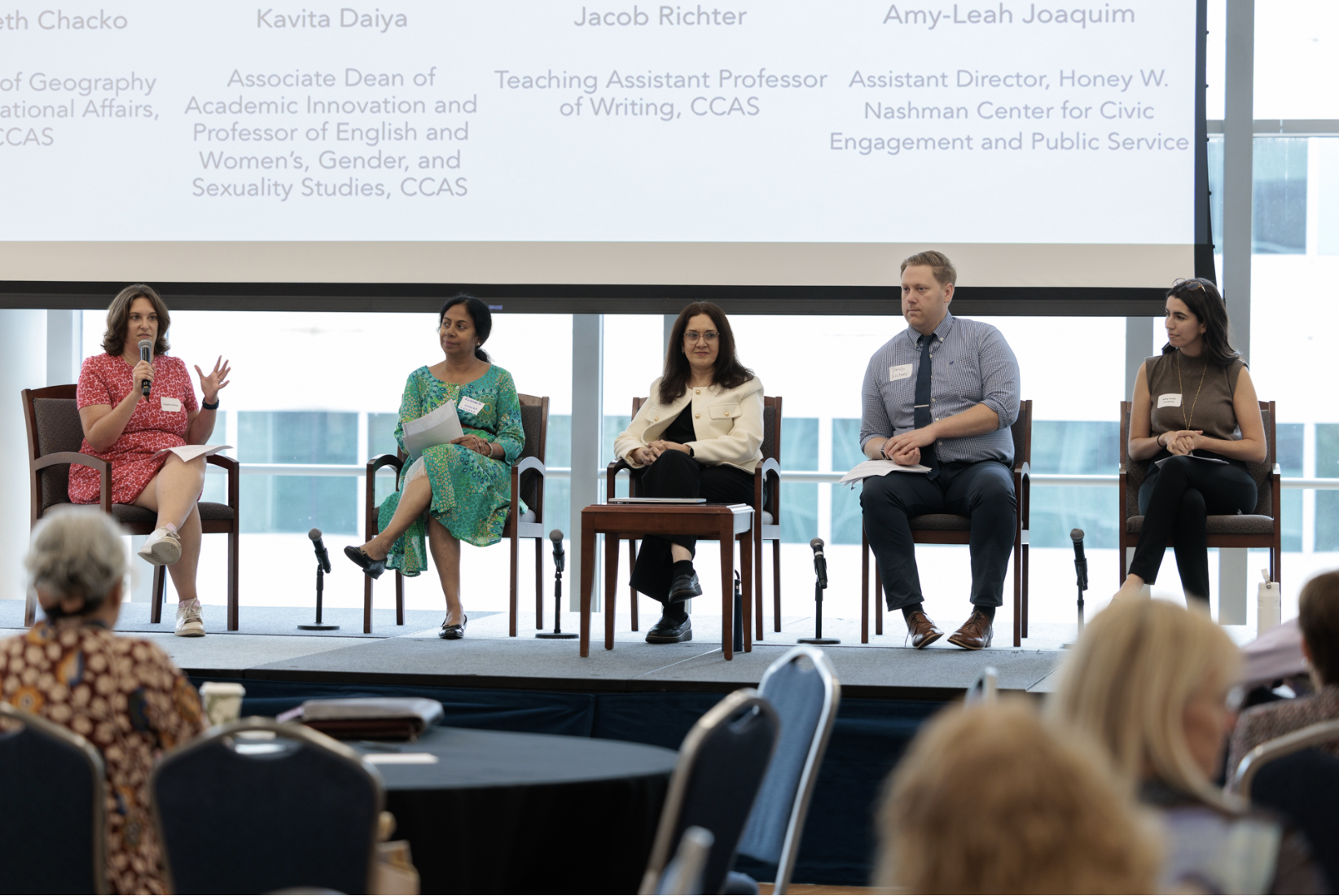
Jacob discussing active learning, civic engagement, and democratic exigencies in writing pedagogy at The George Washington University’s 2025 “Teaching Day” event hosted by the Center for Teaching Excellence
View my Curriculum Vitae
See my Statement of Teaching Philosophy
See my full Teaching Dossier
See my Diversity Statement
Contact: Jacob.richter10@gmall.com / jacob.richter@gwu.edu
 Jacob Richter